AI is most useful in tennis when it does not pretend to know more than your data knows.
You can remember a tennis match.
You can probably remember several.
After twenty or thirty, the problem changes.
You remember the dramatic losses.
The opponent you dislike playing.
The day your serve felt perfect.
The match in terrible wind.
But remembering whether you consistently perform differently against certain opponent styles, in particular conditions or when specific parts of your game rate higher than your opponent's?
That becomes much harder.
This is where pattern analysis becomes useful.
Not because an AI model understands your tennis better than you do.
But because a computer can repeatedly ask the same question across a match history:
When this condition was present, what tended to happen?
That is a much less magical description of AI Insights.
It is also a much more useful one.
1. Start with the difference between a statistic and a pattern
A statistic might tell you:
You won 58% of your recorded matches.
A pattern asks:
Was that result meaningfully different in some repeatable situation?
For example:
- when you rated your return higher than your opponent's,
- on a particular surface,
- against a particular opponent profile,
- in longer matches,
- in official versus friendly competition.
Now the number has context.
The objective is not to find as many relationships as possible.
It is to identify relationships worth looking at more closely.
That final phrase matters.
An insight is not automatically an explanation.
2. Tennis Log does not begin by asking a language model to guess
This distinction is important.
The first layer of the Insights system is deterministic.
It examines structured information already present in your match history and looks for relationships between recorded conditions and outcomes.
That can include things such as:
- match format,
- competition type,
- surface,
- opponent characteristics you recorded,
- your ratings,
- opponent ratings,
- match context,
- other structured fields that are available for enough matches.
In other words, the system is not supposed to invent:
“You struggle against defensive players.”
from nowhere.
There has to be something in the recorded history that generated the observation.
The language-model layer comes later.
That separation is one of the most important safeguards in the feature.
3. Read the denominator before the percentage
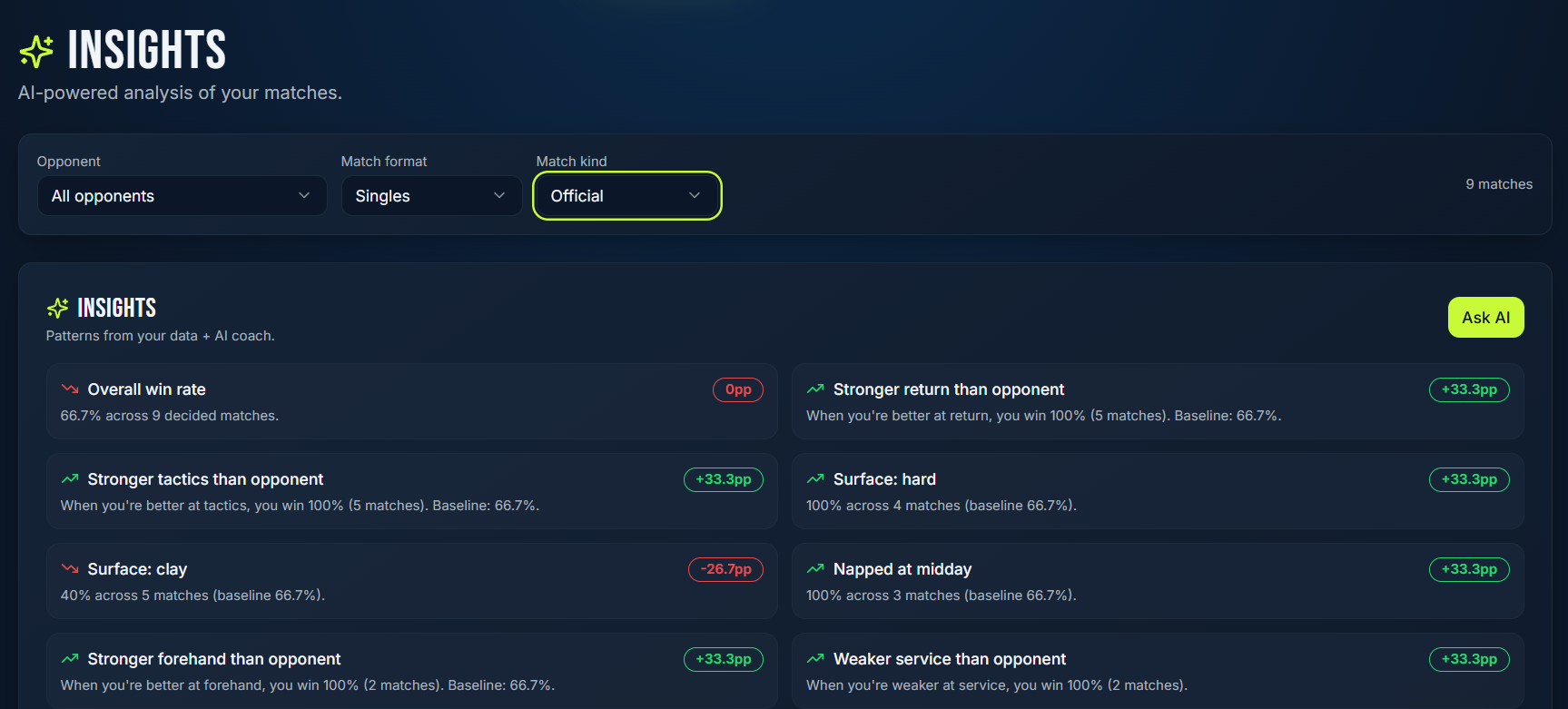
Suppose an insight card says:
You won 100% of these matches.
That sounds extraordinary.
Now look underneath:
5 matches.
You did indeed win five of five.
That is a perfectly real description of those five recorded matches.
It is not proof that the same condition guarantees future success.
This is why Tennis Log shows the match count alongside the percentage.
Read both.
Compare:
100% — 2 matches
with:
72% — 25 matches
The first number looks stronger.
The second may deserve far more attention.
A useful AI interface should make small samples visible rather than hide them behind impressive percentages.
4. A pattern is strongest when it survives more data
You do not need a universal rule such as:
ten matches means real, five means maybe, three means meaningless.
Evidence does not become trustworthy at one magical threshold.
Instead ask:
- How many matches sit behind this result?
- Would one more win or loss change it dramatically?
- Has the pattern persisted as new matches were added?
- Does it remain when you use a sensible filter?
- Does it make tennis sense when you look at the actual matches?
Confidence should grow gradually.
An insight based on three matches can still give you an interesting hypothesis.
It should simply be treated as a hypothesis.
5. Percentage-point differences need the same caution
Imagine your normal win rate is 55%.
In a particular group of matches it is 75%.
The difference is +20 percentage points.
That makes the relationship easy to see.
It does not tell you why it exists.
Perhaps the condition genuinely matters.
Perhaps those opponents were weaker.
Perhaps the matches came from a short period when you were playing well.
Perhaps two variables overlap.
The delta is a useful description:
This subset differs from my baseline.
It is not:
This variable caused the difference.
That distinction is central to using AI Insights responsibly.
6. The most interesting insight may be the one you did not think to check
Players naturally look for familiar explanations.
Forehand.
Backhand.
Serve.
Fitness.
Mental game.
But match logs can contain combinations that are difficult to hold in memory.
Perhaps your results look different:
- against a certain play style,
- under a particular match format,
- when one performance rating is consistently above or below your opponent's,
- in matches of a certain type.
You might never have manually created that comparison.
A pattern engine can.
Its value is partly search coverage.
It can look through many reasonable comparisons without requiring you to build every chart yourself.
That does not make every result meaningful.
It makes more potentially useful questions visible.
7. Lifestyle correlations require extra restraint
Suppose your history appears to show better results in matches after more sleep.
It is tempting to conclude:
Sleep is the reason I won more.
The data does not establish that.
Perhaps those matches happened on weekends.
Perhaps opponents were different.
Perhaps they were played at a different time of day.
Perhaps the sample is small.
Perhaps the relationship is genuine.
The correct language is:
My recorded results differ under this condition. Is that pattern worth watching?
The same applies to food, fatigue, workday context or other lifestyle variables.
Correlations can be extremely interesting.
They should not be converted automatically into medical, nutritional or causal advice.
8. Opponent patterns can be tactically useful without becoming stereotypes
Opponent profiling is another interesting use of a match history.
Suppose you consistently record opponent characteristics such as handedness, playing style or particular stroke characteristics.
After enough matches, your history may suggest that your results differ against one group.
For example:
Results have been weaker against left-handed opponents.
That does not mean:
Left-handed players beat me because of the wide slice serve.
Maybe they do.
But the statistic did not observe the mechanism.
The insight gives you a question to bring back to the court:
- Which patterns actually caused problems?
- Was return position involved?
- Did the same thing happen across multiple opponents?
- Is the difference still visible as more matches accumulate?
The best opponent insight improves preparation.
It does not replace scouting.
9. Ratings become more useful when compared relationally
Tennis Log lets you rate both yourself and your opponent across several aspects of performance.
That enables questions such as:
What tends to happen when I rate my return higher than my opponent's?
or:
What happens in matches where I feel the opponent had the stronger tactics?
This is more interesting than reading the rating alone.
But remember what the data is.
The ratings are your assessments.
If an insight says that you won five of five matches in which you rated your backhand higher than your opponent's, the arithmetic may be exact.
The underlying ratings remain subjective.
That does not make the insight useless.
It means the correct interpretation is:
When I perceived this relative advantage, the recorded outcomes looked like this.
Over time, consistent self-rating can become informative.
10. AI becomes dangerous when it upgrades correlation into certainty
This is perhaps the simplest test for an AI insight.
Compare:
Your results have been lower in long matches.
with:
Your fitness is costing you matches.
Those are not equivalent.
The first describes data.
The second diagnoses a cause.
Several other explanations could exist:
- stronger opponents create longer matches,
- close matches naturally last longer,
- tactical choices change,
- physical fatigue contributes,
- the sample is small.
A useful AI system should preserve the uncertainty.
A good insight narrows the investigation.
A bad one ends the investigation too early.
11. What the “Ask AI” layer adds
A list of pattern cards can become difficult to synthesize.
This is where the language-model layer can help.
Its useful jobs are things such as:
Summarising
Turning several cards into a readable overview.
Connecting
Pointing out that two apparent patterns may overlap.
For example:
Your results look better on one surface, but many of those matches were also against a particular type of opponent.
That is a reason to investigate further.
Prioritising
Helping identify which observations might deserve attention first.
Suggesting questions or practice experiments
For example:
In the next few matches, track whether this return pattern continues against comparable opponents.
Those are appropriate uses of a language model.
The model is helping you reason about evidence.
It is not generating evidence.
12. What “Ask AI” should not add
The language model should not manufacture certainty that the underlying data does not contain.
If a pattern comes from three matches, a polished paragraph does not turn those three matches into thirty.
If the data shows association, elegant prose does not make it causal.
If a particular stroke was not recorded or rated, the AI should not pretend it watched the stroke.
This gives you a practical rule:
The narrative can be richer than the card. The evidence cannot be richer than the data.
Whenever the wording sounds more certain than the numbers underneath it, trust the numbers.
13. Privacy matters because personal analysis can become very personal
A match log can contain information that you would not want casually passed around.
Tennis Log therefore uses a filtering/allowlist layer before AI processing.
The language-model workflow does not need your account identity to discuss your tennis patterns.
Identifiers such as your name or email are not what makes the analysis useful.
Where opponent references are needed, the implementation can use temporary/pseudonymous labels rather than exposing the opponent's identity.
Health/watch-related information is handled separately and subject to the relevant consent controls.
The useful principle is:
send the minimum information necessary for the analysis being requested.
That is more important than making the AI sound omniscient.
14. Generic AI coaching and grounded AI analysis are different products
Ask a general-purpose AI:
How can I improve my tennis?
and it can provide reasonable general advice.
Improve your footwork.
Work on your second serve.
Play high-percentage patterns.
Stay composed.
Useful perhaps.
Personal?
Not really.
A grounded system has a different starting point:
Here is what has repeatedly happened in my own recorded matches. What is worth investigating?
Now the AI has evidence to discuss.
The quality still depends on the evidence.
Poor data produces poor analysis.
Tiny samples produce uncertain analysis.
Subjective ratings remain subjective.
But at least the conversation begins with your history rather than a generic tennis-player stereotype.
15. More fields do not automatically mean better insights
There is a temptation to record everything because the AI might someday find something.
That can turn match logging into a chore.
It also creates more opportunities for coincidental relationships.
Track information because it has plausible relevance to questions you care about.
If you never plan to investigate time of day, perhaps you do not need it.
If surface matters greatly to your game, record it consistently.
If you want opponent-style comparisons, those fields need enough repeated observations to become useful.
The engine cannot find a reliable pattern in data that is:
- never recorded,
- inconsistently recorded,
- or present in only a handful of matches.
Better data is not maximum data.
It is consistent data with a purpose.
16. Beware of over-filtering
Suppose you begin with forty matches.
Then filter:
- Singles
- Official
- Clay
- Evening
- Last six months
Perhaps only three matches remain.
The resulting percentage can look extremely dramatic.
It is also based on almost nothing.
Filters are useful for making comparisons more relevant.
They are dangerous when they reduce the dataset until every result looks exceptional.
Before reacting to any insight, check:
How many matches are left?
That question should become automatic.
17. Negative insights are not automatically more important
The old article suggested that negative patterns are inherently more actionable.
I would not keep that rule.
Sometimes a negative pattern deserves attention.
Sometimes your highest-value insight is a positive one:
This pattern appears to work consistently.
Protecting a strength matters.
You may discover that:
- a particular tactical pattern is reliable,
- one type of match suits you,
- a relative skill advantage consistently appears in wins.
Improvement is not only error correction.
A good review asks two questions:
What should I investigate changing?
and:
What should I be careful not to lose?
18. Turn insights into experiments, not commandments
Suppose an insight suggests that your results are weaker when your return rating is below your opponent's.
Do not immediately rebuild your training month around return.
Instead, form a testable experiment.
For example:
For the next few matches, I will pay particular attention to first-return depth and record whether I begin more return points from neutral positions.
Now the insight has influenced behaviour without pretending to know the entire cause.
Later, return to the data.
Did anything change?
That is how AI Insights should feed development:
pattern → question → experiment → new evidence
not:
pattern → diagnosis → command
19. Re-running the analysis after every match is not always useful
One new match may change a small dataset significantly.
That does not mean every shift deserves interpretation.
For many patterns, it is more useful to let some additional evidence accumulate before revisiting the conclusion.
You can still look after every match.
Just resist the urge to create a new training plan every time one percentage moves.
The objective is not to make Insights constantly exciting.
Stable patterns are often more valuable than constantly changing ones.
A practical AI Insights review
You do not need a complicated monthly ritual.
Try this:
1. Check the match count
Which insights have enough observations to deserve attention?
2. Read the pattern literally
What does it actually say happened?
Do not add the cause yet.
3. Check the baseline
How different is the subset from your broader history?
4. Look for overlap
Could another variable explain the same group of matches?
5. Choose one useful positive
What appears worth preserving?
6. Choose one useful question
What pattern deserves investigation?
7. Use Ask AI as a second opinion
Does the narrative suggest a connection or experiment you had not considered?
8. Decide for yourself
The final training decision remains yours.
That review can take a few minutes.
The difficult part is not reading the cards.
It is resisting false certainty.
AI should make your questions better
The most convincing AI product is not the one that sounds most certain.
It is the one that knows where certainty ends.
Tennis Log can calculate relationships across a history more consistently than you can remember them.
It can surface combinations you may never have thought to check.
A language model can then help you read those patterns together.
That is useful.
But the system did not watch your match.
It did not feel the wind.
It did not see the return you framed at 4–4.
And a correlation in your database is not automatically a cause in your tennis.
So use AI Insights as a pattern surface.
Let it say:
Something interesting may be happening here.
Then go back to the matches.
Look at the sample.
Read your notes.
Test the idea.
Add more evidence.
The best outcome is not an AI that tells you what your tennis means.
It is an AI that helps you notice which questions about your tennis are finally worth asking.
Further reading
International Tennis Federation — Rules and Regulations For official tennis terminology and scoring context.