
Subjective ratings do not become objective because you put a number on them. Their value comes from using the same scale consistently enough to notice how your own perception changes.
A tennis match contains things the scoreboard can measure easily.
You won 6–4, 3–6, 10–7.
You held seven service games.
You were broken four times.
You hit three double faults.
Then there are things that are much harder to extract from the score.
How comfortable was your forehand?
Did your movement feel sharp?
Was your return reliable?
Did you make sensible tactical decisions?
Did you remain focused when the match became close?
How strong did the opponent feel in those same areas?
These are not objective measurements.
They are judgments.
That might sound like a weakness.
Used carefully, it is actually the reason they can add something different to a match log.
The aim of a 1–10 rating is not to discover the scientifically correct number for your backhand.
There is no such number.
The aim is to preserve:
How did this part of my tennis feel and perform in this particular match, using approximately the same scale I have used before?
Do that consistently and the ratings can become useful context around the harder numbers.
1. A rating is an observation, not a measurement
Suppose you rate your forehand:
7/10
What exactly has been measured?
Nothing in the way that a stopwatch measures time.
Another observer might give it a 6.
A coach might give it an 8 for technical execution but a 5 for shot selection.
You might give the same forehand a different score tomorrow after remembering the match differently.
That does not make the rating meaningless.
It defines what kind of information it is:
subjective match data.
The mistake is not using subjective ratings.
The mistake is pretending they have the precision of objective measurements.
2. Rate the match you played, not the player you think you are
This distinction is essential.
Imagine you normally consider your forehand your best shot.
Today it was poor.
If you think:
My forehand is a good shot, so I should give it an 8
you are rating your general tennis identity.
That is not what the match rating is for.
The useful question is:
How did my forehand perform today relative to what this scale usually means for me?
Your strongest stroke can have a bad match.
Your weakest stroke can have an excellent one.
If the ratings simply reproduce your permanent beliefs —
forehand 8, backhand 6, serve 7 —
every time, the sliders add almost no new information.
Variation is not a failure of the rating system.
It is what you are trying to capture.
3. Build personal anchors instead of searching for universal ones
What should a 5 mean?
There is no universal answer that works perfectly across players.
A recreational beginner's 7 is not directly comparable with an advanced competitor's 7.
It does not need to be.
You need an internally stable scale.
One practical approach is:
1–2: exceptionally poor for your usual standard 3–4: clearly below your normal performance 5–6: around your normal range 7–8: clearly strong for you 9–10: unusually exceptional performance
Notice what this scale does not say.
It does not claim:
8 = advanced tennis.
It says:
8 = this dimension was unusually strong relative to the way I normally experience my own matches.
That makes longitudinal comparison much more meaningful.
4. Do not be afraid of the middle of the scale
People often dislike giving themselves a 5.
It feels mediocre.
So the scale slowly drifts upward.
A normal match becomes 7.
A good match becomes 8.
An excellent match becomes 9.
Soon everything lives between 7 and 9 and the slider has almost no resolution left.
There is nothing wrong with the middle.
If 5–6 represents ordinary performance for you, then many matches should contain ratings around 5–6.
That gives the exceptional days somewhere to go.
And the poor days too.
5. The score should not choose the rating for you
You win.
Everything feels better.
You lose.
Everything suddenly looks worse.
This is one of the easiest biases to introduce.
Suppose you lose 6–4, 6–4 but your backhand was unusually reliable.
The fact that you lost does not require a low backhand rating.
Now imagine you win despite serving poorly because your opponent donated many return errors.
The victory does not make your serve excellent.
Try asking:
If I did not know the final score, how would I describe this part of my performance?
You cannot completely remove outcome bias.
You can at least notice it.
6. Rate specific behaviour when possible
The word tactics can feel vague.
So can movement, focus, return or confidence.
Before moving the slider, briefly think about what actually happened.
Instead of:
My movement felt like a 5.
think:
I was repeatedly late when recovering from the forehand corner.
Instead of:
Return 8.
think:
I consistently produced enough depth to start rallies neutral.
The number preserves the summary.
The behaviour gives it meaning.
This is where a short match note can become extremely useful.
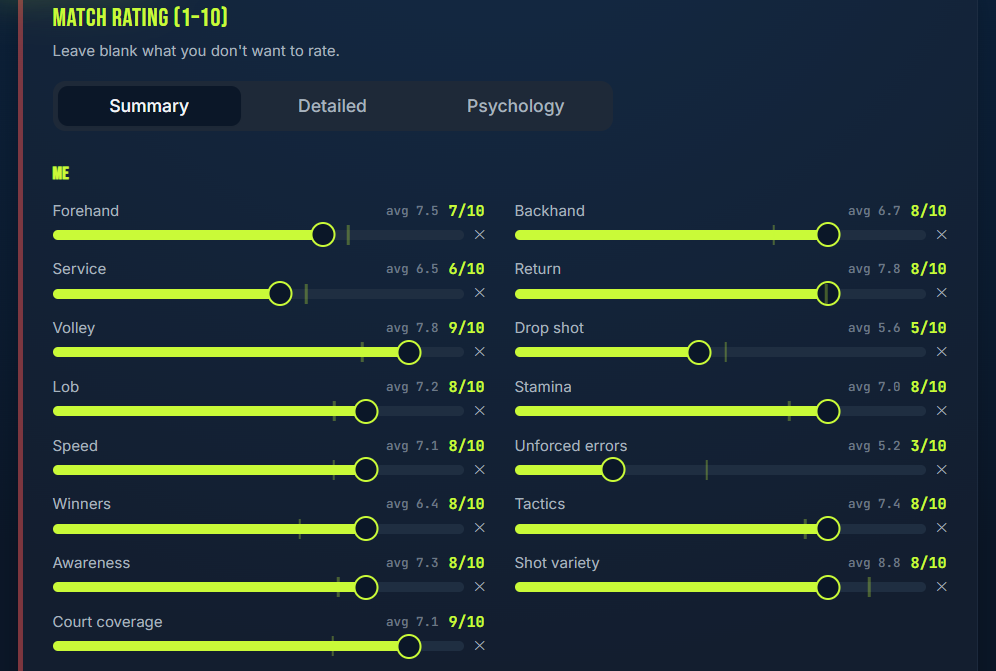
7. Your opponent's rating is subjective too
Rating the opponent gives useful context.
But it creates another potential misunderstanding.
You are not producing an official scouting grade.
You are recording:
How I perceived this opponent's performance in this match.
Suppose their forehand gave you enormous trouble.
You rate it 8.
That is useful.
It does not establish that their forehand is objectively an 8 against every player at every level.
Maybe your own patterns fed that shot particularly well.
Maybe they played exceptionally that day.
Maybe another opponent would expose it differently.
So opponent ratings should remain what they are:
your structured observation of the matchup.
Not a universal ranking system.
8. Relative ratings can reveal interesting matchup questions
Suppose over several matches you notice that you often rate your return lower than your opponent's serve.
That may be interesting.
Or perhaps your movement is frequently rated higher than the opponents you beat.
Again:
interesting does not mean causal.
A rating gap can prompt questions such as:
- Was this perceived disadvantage actually visible in the point patterns?
- Does the same gap appear against several opponents?
- Does it coincide with objective serve/return results?
- Is this something I should observe more carefully next time?
What it should not automatically say is:
This is your biggest weakness. Train it immediately.
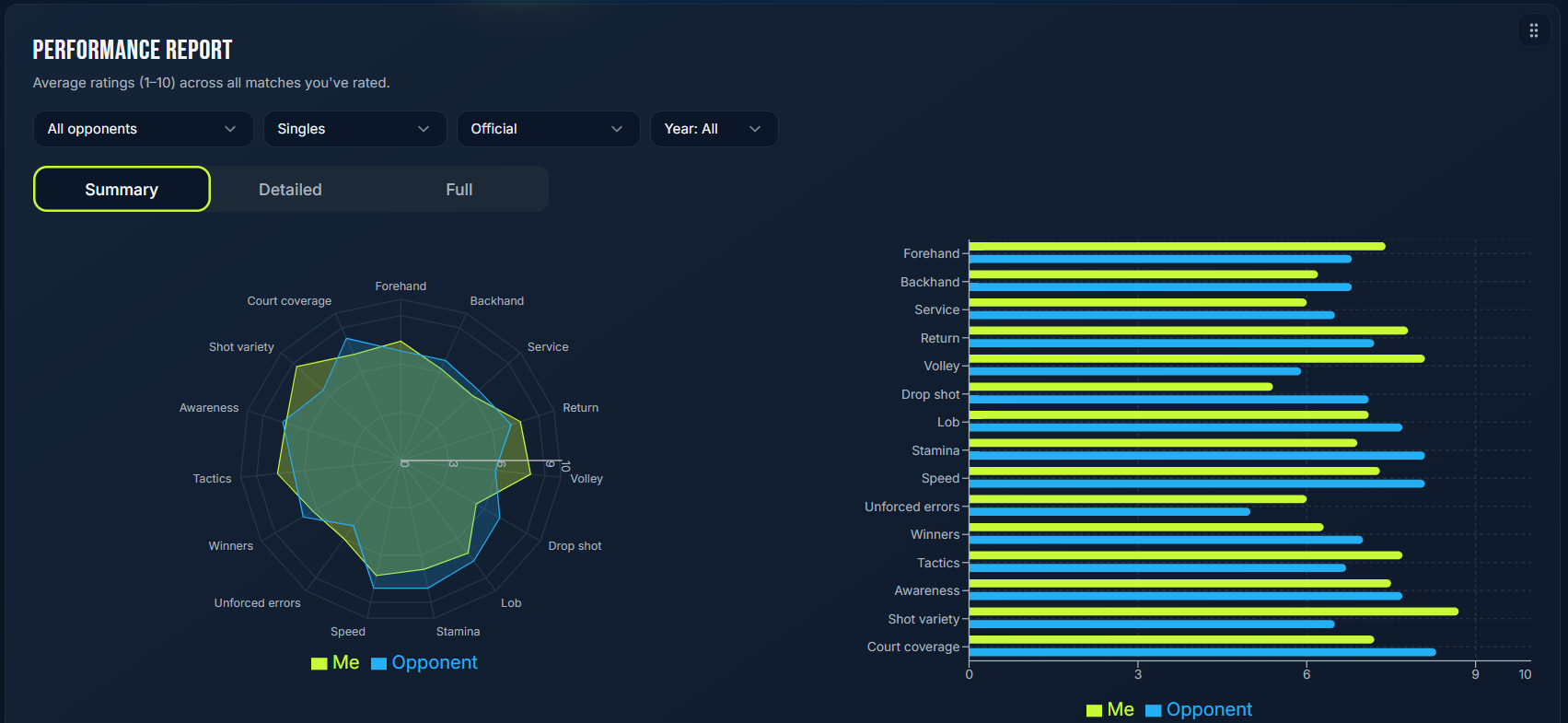
The largest gap on a radar chart is a visual difference.
It is not automatically the highest-value training priority.
9. Combine subjective ratings with objective match information
Ratings become much stronger when they can be compared with something else.
Suppose you rate your serve highly.
But your service-game results were poor.
That does not automatically mean your rating was wrong.
Perhaps:
- the opponent returned exceptionally well,
- your first serve worked but your second did not,
- the serve created good starts but later shots broke down,
- a few service games swung on small samples.
The disagreement itself is interesting.
Ask:
Why did my perception and the scoreboard tell different stories?
That is much better than deciding one source must be wrong.
10. Agreement between signals is useful too
Now imagine that over several matches:
- you rate movement poorly,
- late-match performance deteriorates,
- your notes mention arriving late,
- long matches show the same pattern repeatedly.
Several observations are pointing toward the same situation.
You still should not leap directly to:
Fitness is definitely the cause.
But the pattern deserves more attention than a single low slider.
Good analysis often comes from independent clues agreeing.
11. Do not turn correlations into coaching instructions
Suppose Tennis Log finds:
In matches where you rated your return highly, you won more often.
Useful.
But this does not mean:
Raise your return rating and you will win.
Obviously.
More subtly, it also does not necessarily mean:
Return is your most important training priority.
Perhaps strong return performance reflects:
- weaker opposing serves,
- a favourable matchup,
- better overall days,
- other variables that occur in the same matches.
The right next question is:
What was I actually doing differently on return in those matches?
The rating helps locate the pattern.
Tennis analysis still has to interpret it.
12. Treat AI findings about ratings with the same caution
This matters because subjective ratings can feed AI Insights.
Suppose the system identifies:
You have better results when your self-rated return is higher than your opponent's.
The arithmetic behind the subset may be perfectly accurate.
But both ratings began as subjective observations.
Therefore the interpretation should remain:
When I perceived this relative advantage, results tended to look different.
That may be valuable.
It is not the same as an instrument measuring an objective difference in return skill.
The AI can calculate the relationship precisely.
It cannot make the underlying judgment objective retroactively.
13. Consistency matters more than perfect calibration
You will never rate every match perfectly.
That is fine.
Suppose your personal 6 today might have been a 5 last month.
Some drift is inevitable.
The aim is not perfect calibration.
It is enough consistency that broad changes remain interpretable.
You can help by asking the same questions each time.
For example:
Was this below normal, normal, strong or exceptional for me?
That may produce more stable ratings than trying to solve:
What is the objectively correct number between 1 and 10?
There isn't one.
14. Be careful when your scale changes
Sometimes your tennis improves and your standards rise with it.
Six months ago, a certain level of serving felt like an 8.
Today it feels like a 6 because you expect more from yourself.
That creates an interesting problem:
rating drift.
The score has fallen even though the skill may have improved.
This does not invalidate longitudinal ratings.
It means changes should be interpreted alongside objective results and match notes.
If a slider suddenly drops while the related match performance improves, your internal standard may have moved.
That itself is useful information.
15. Compare similar match contexts where possible
A rating can mean different things under different demands.
Your movement in doubles and singles is not tested identically.
Neither is return.
Neither is court coverage.
That does not mean you need separate personal scales for everything.
It means filters matter.
If you want to investigate:
Is my singles movement improving?
look primarily at singles.
If you want:
How did I feel across all tennis this month?
a combined view may be fine.
Match context determines the question.
16. You do not need to rate everything every time
The ideal tracking system is the one you continue using.
If a rating form becomes homework, consistency eventually disappears.
Prioritise the dimensions relevant to the match and to the questions you are currently following.
If the application distinguishes between core and more detailed ratings, use that flexibility.
There is little value in forcing yourself to invent a confident score for a shot that barely appeared.
It is better to have fewer thoughtful ratings than a large set of numbers entered mechanically.
17. “I don't know” is a legitimate answer
Suppose you barely came to the net.
How good was your volley today?
You may not have enough evidence.
Or perhaps you cannot meaningfully judge the opponent's drop shot because they attempted one.
Do not manufacture information because the slider exists.
Where the product allows a dimension to remain unrated, that may be better than false precision.
Missing data is sometimes more honest than invented data.
18. Rate reasonably soon — but do not mythologise memory
There is value in recording observations while the match is still relatively fresh.
Details disappear.
Emotional impressions also evolve.
But we should avoid the old claim that immediate memory is automatically the “truthful” one.
Immediately after a difficult loss you may be:
- frustrated,
- euphoric,
- disappointed,
- physically exhausted.
Those states can bias judgment too.
The practical rule is simpler:
Rate while you can still remember the match clearly, and use the same general timing habit consistently.
There is no magical five-minute window.
19. Do not rewrite history to make a trend prettier
Suppose weeks later you decide:
I was too harsh on my forehand in that match.
Should you change the old rating?
Usually, longitudinal data is more interpretable if past judgments remain as they were recorded.
You are not only preserving what happened.
You are preserving how you perceived it at the time.
There may be legitimate reasons to correct a clear data-entry mistake.
That is different from retrospectively polishing every rating with hindsight.
20. Use the radar to choose questions, not answers
A performance radar is powerful visually.
Your eye immediately sees:
- peaks,
- dips,
- differences,
- asymmetry.
That makes it tempting to create a simple rule:
largest deficit = train this.
Resist it.
Instead ask:
Is this gap repeated?
Does it matter to the way I play?
Does objective match information support it?
Can I identify the situations producing it?
Is it trainable?
Only after those questions does training priority make sense.
The chart begins the conversation.
A practical 5-minute rating review
Once you have several rated matches, try this:
1. Look for stability
Which ratings remain roughly consistent?
These may describe your perceived baseline.
2. Look for repeated changes
Which dimensions repeatedly move under particular conditions?
3. Compare yourself and opponents
Where do relative differences appear often enough to be interesting?
4. Check objective data
Do serve/return/game results support or complicate the rating story?
5. Read your notes
What was actually happening on court?
6. Choose one question
Not:
What is my worst rating?
but:
What repeated rating pattern deserves investigation?
Five minutes is enough.
The aim is to focus attention, not produce a report card.
Ratings should become more useful as they become less dramatic
The first time you use sliders, every number feels significant.
Forehand 7.
Return 4.
Movement 8.
Interesting.
After many matches, an individual rating becomes less important.
That is good.
Now you can ask more useful questions:
- What is normal for me?
- What varies?
- Under what conditions?
- Which perceived changes match objective outcomes?
- Which disappear when more matches are added?
- Where does my own perception consistently disagree with the scoreboard?
That is a richer use of subjective data.
The sliders are not trying to tell you who you are as a tennis player.
They preserve one perspective:
how you experienced your own tennis and your opponent's tennis in that match.
Repeated consistently, that perspective can become something worth comparing.
Not because the numbers are perfectly objective.
Because they are imperfect in roughly the same way over time.